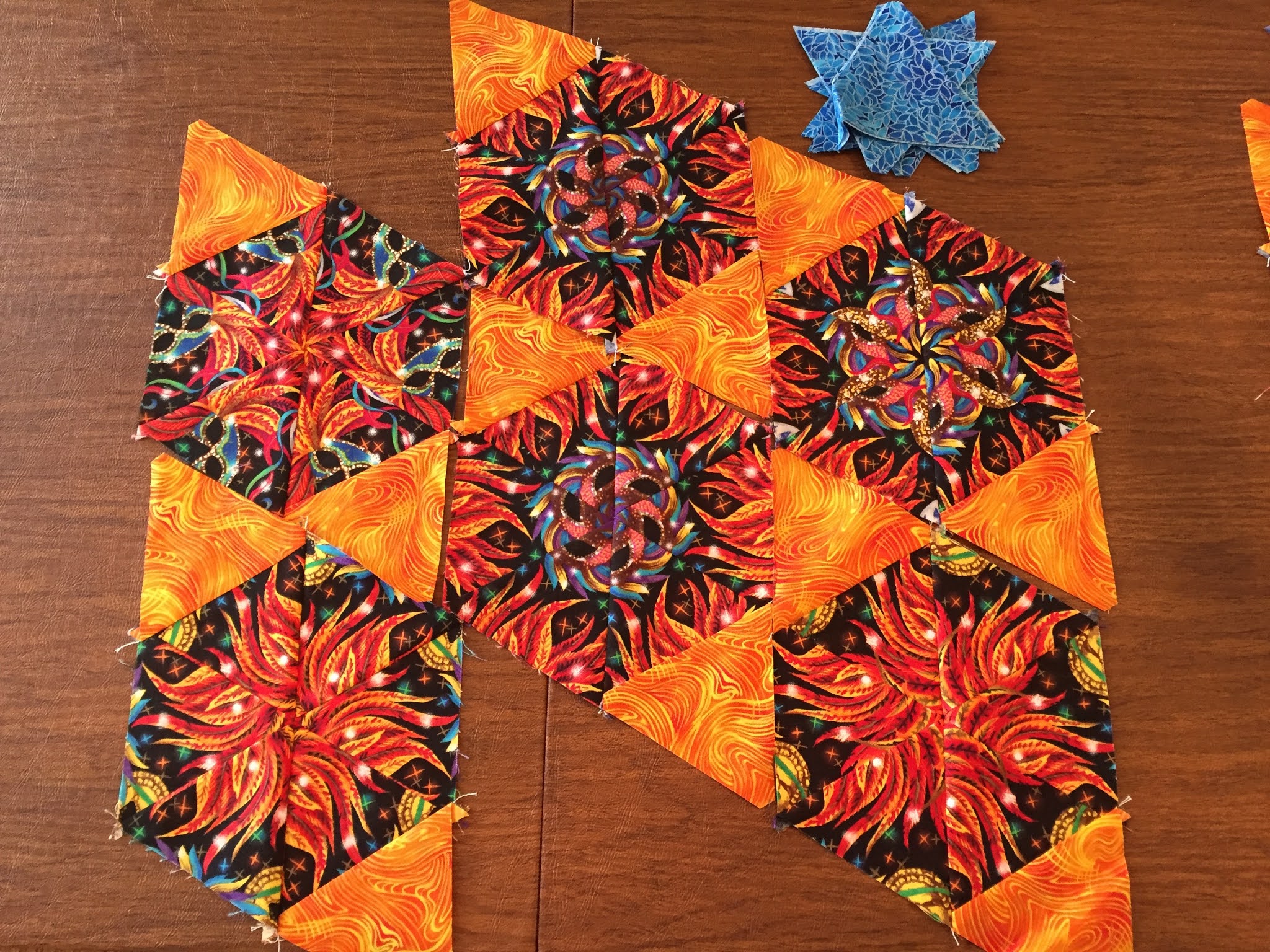
The quilt of hexagons is getting closer to being finished. Yesterday I finished assembling the last of the thirteen columns of hexagon medallions. The columns are not joined yet. I have a few triangles to swap out. A few are whoopsies I need to fix and some are optional design changes I want to make. Having come out of the frustrating doldrums stage, I am enjoying this quilt now.
In the following photo, see that star with five orange points and one purple point? It was an original design choice how to handle the interface between color sections. Although I was consistent in my approach to the orange, I now think it would look better if I change all those stars with an odd man out sixth point to have all points the same. It means taking out two short seams to exchange the color in those columns I have not yet joined, and picking out three seams if I have joined the columns. I have come this far; I will go the extra distance.

One hundred seventy of those hexagon shapes are symmetric about three axes like a kaleidoscope. Per Encyclopædia Britannica here is how a kaleidoscope works.
The incline of the two mirrors inside a kaleidoscope determines the number of times the pattern created by the reflection of an object is repeated. If the mirrors are positioned at a right angle, four images of the object can be seen. If the mirrors' surfaces are positioned at 60°, six images of the object appear.
For three of the total 173 hexagons shapes, I substituted in a hexagon of the source fabric without any seams and no axes of symmetry. These three are camouflaged so it will be fun to find them in the finished quilt. I used a Hex N More ruler to center about certain features; in this next photo that feature is a bird mask. The "N More" feature of the ruler is so true. I use this ruler to cut 60° pieces, yes but it is especially useful to cut 120° pieces by placing masking tape where needed.

In addition to the ruler I used specialty pins. The numbered pins were extremely helpful in keeping the medallions in the design order I'd decide upon in the layout I had agonized over. The pins were pricey but well worth it. I oriented the pins so that they helped me alternate seam pressing direction to reduce bulk when joining the columns. In the second photo, pins 4, 3, 2 point left and pins 5, 4, 3 point right, assuring that the columns-to-column seams will have minimized bulk at the hexagon points. Each pin sits on the side of the seam toward which the seam allowance had already been pressed when the half medallions were formed. The seams alternate direction when joined as a column.


There are two other hexagons hidden within the quilt top. Each of them features a mask such as might be worn at Mardi Gras celebration or Masquerade ball. I am considering naming the quilt Masquerade. Mardi Gras makes me think of wild drunkenness and debauchery. The word masquerade makes me think of the song
Masquerade from Phantom of the Opera – much more refined and appealing. Here are some of the lyrics.