Showing posts with label HungryCaterpillar. Show all posts

Tuesday, April 21, 2020

Munch... Munch... and Much More

The Very Hungry Caterpillar made a second appearance on the quilt for my grandson in Oklahoma who will turn 5 in July. There is little difference between his quilt, MUNCH... MUNCH...  and the previous hungry caterpillar quilt titled MUNCH..., made for his cousin in Southern California who turned two mid-April. The binding fabric and the FMQ pattern are essentially the same for the two quilts. I completed MUNCH... in the beginning of March and MUNCH... MUNCH... ten days later. Previous three posts on these two quilts are dated 4/10/20, 4/11/20, and 4/13/20. Both quilts finished at 45" x 63".

Here is a comparison of the echo quilting between MUNCH... on the left for the two year old and MUNCH... MUNCH... on the right for the five year old. I thought there might be an improvement with practice but not so. Even if I squint, I cannot detect any increased steadiness in my hand as my confidence built. What a relief! No improvement! There is no need for me to feel guilty that one quilt is better than the other and I am showing favoritism between grandsons. I did quilt the second quilt more quickly than the first because my decisions were pre-made. I quilted all the 50 weight thread first and then all the 40 weight. Since I did not switch threads as often, I saved time with the tension adjustment back and forth between the 50 weight white thread and the 40 weight variegated thread. In that sense, the experience gained was not for nought.


The name MUNCH... MUNCH... indicates that an older, larger, caterpillar was at work. Two other notably different variations:
  • The backing fabric is primary colored irregular shapes with holes nibbled out by the few caterpillars scattered about.
  • The labels are green grosgrain the current favorite color of the soon-to-be five year old, rather than blue grosgrain, like the stripes on the backing fabric of the other quilt.


I was proud of the backing seam. I was able to match the print so it is nearly invisible. It runs vertically down the center of the following photo. On the quilt it is a horizontal seam. The backing fabric runs "sideways" which means the caterpillars are not oriented up and down. No worries. I do not think that the caterpillars in nature are too gravity challenged. They crawl every which way on the leaves they munch. Grandpa's fingers and toes are included in the third photo.


Since these quilts had been twelve years in the making, I had plenty of time to collect related items to give with the quilt. In the Home Goods store a couple years ago, I happened upon some Very Hungry Caterpillar musical instruments – a harmonica, a pair of castanets, and a recorder. The recommended age was 2+ so they would be perfect. I bought two of each instrument, remembering I had those two kits to make, and stored the toys away. I put them in the plastic bin with the kits so I would be able to find them when the time came.


Recently a quilt friend of mine came to a meeting with an adorable tote bag that was made up like a old-fashioned library checkout out card. She told me that it had been a gift from her daughter from a web site called Out Of Print. Imitation is the highest form of flattery, so I went to the website and bought one for myself. While I was there online shopping, I hit the jackpot of Very Hungry Caterpillar paraphernalia. There was a zip pouch and I bought two. The pouch was the perfect size to hold the three instruments. When I removed the instruments from their packaging, I could fit them, as well as the card for each, within the pouch and still be able to zip it closed.


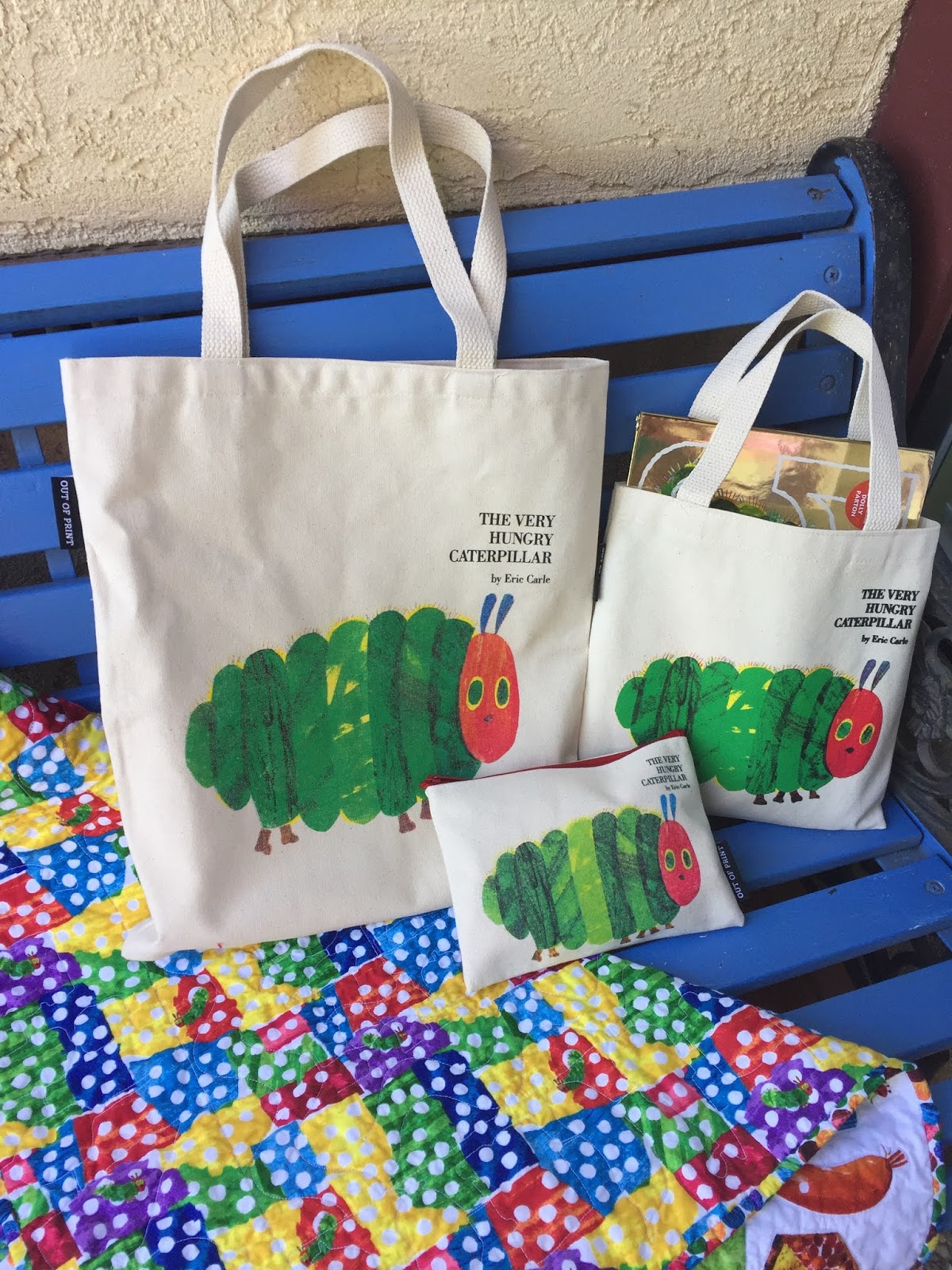
The Out Of Print site also had an adult caterpillar tote and I child-size caterpillar tote. Naturally I bought two of each as well. The reverse side of the totes and the zippered pouch with images of one apple, two pears, three blueberries, four strawberries, and five oranges is also whimsically adorable. The larger tote is perfectly-sized to hold the folded up quilt; the smaller tote is well-sized to hold a hard cover copy of the book The Very Hungry Caterpillar. I included a 50th anniversary edition.


As I was preparing to package the second quilt and assorted accessories for mailing to Oklahoma, my husband tossed this envelope on my cutting mat. He had come across it while cleaning out the garage, having been saving it for the commemorative stamps since he is a stamp collector. There, in the upper right corner, was a 2006 issue stamp for The Very Hungry Caterpillar.


The US Stamp Gallery posts the following description for the book The Very Hungry Caterpillar commemorated by the 2006 issue stamp. The 30 million copies sold at the time cited in the website's posting has been surpassed.


The most recent information I could find on the publication popularity of The Very Hungry Caterpillar book was from the Wikipedia entry for the author Eric Carle stating
He is most noted for The Very Hungry Caterpillar, a picture book that has been translated into more than 66 languages and sold more than 50 million copies, equivalent to 1.8 copies sold every minute since it was published in 1969.
Great Britain has also issued a stamp jointly with the United States in 2006, honoring the book. Great Britain's stamp includes little holes in it, as if that very hungry caterpillar had taken a few bites out of it.


From a stamp collector's blog I learned that Japan issued a souvenir sheet in 2018 commemorating The Very Hungry Caterpillar.


Since my daughter usually takes pictures of her quilts and clothing creations outdoors on her front porch, I decided to do the same for what I was giving her son, my grandson. First is the quilt next to its small pouch of musical instruments. Then follows the quilt with a corner flipped down to show the backing along with the other two tote bags.


Here is a closeup of that famous and quite plump caterpillar both on the tote bags and on the bottom panel of the quilt.


Here is a closeup up of more of the FMQ: the wavy caterpillar-like lines in the solid borders, the stitching around the snacks, and the wavy grid in the letter corner blocks.


The 50th anniversary addition of The Very Hungry Caterpillar is shown juxtaposed to the label of the quilt named Munch...Munch....


All is documented, ready to be packed up, and then mailed off. Happy Birthday, Isaiah!


Per Linn's Stamp News the caterpillar stamp is one of eight commemorative stamps in the series Favorite Children's Book Animals. It features creatures from Eric Carle’s The Very Hungry Caterpillar, E.B White’s Charlotte’s Web, Dr. Seuss’ Fox in Socks, Lucy Cousins’ Maisy’s ABC, Maurice Sendak’s Where the Wild Things Are, Margret and H.A. Rey’s Curious George Flies a Kite, Ian Falconer’s Olivia, and Leo Lionni’s Frederick.


I am very familiar with five of the characters but not so much with Maisy, Olivia, and Frederick. I intend to learn about each of those remaining three forthwith. But I have no intentions of making seven other quilts themed for Favorite Children's Book Animals. Linking up with Main Crush Monday #173 at Cooking Up Quilts.

Monday, April 13, 2020

Finishing First Caterpillar Quilt and Naming

Naming my quilts is a finishing touch for me. Hmm... how to name two, almost identical quilts for two male cousins? Placing VERY HUNGRY CATERPILLAR in the title was rather long. Even shortening the phrase to CATERPILLAR was lengthy and still needed a distinction for the two boys. Adding "I" for the first quilt and "II" for the second quilt presumed a hierarchy and favoritism I did not have nor wanted to project. Then I pictured this itty bitty caterpillar chomping his way though all that food and thought of the Fritos corn chip jingle from years ago. You can hear it in the final 15 seconds of this one minute animated commercial from the 60's
Munch, munch, munch a bunch-a Frito's –– corn chips.
It's not polite to smack your lips
But you can't help it, with Frito's corn chips.
Munch, munch, munch a bunch-a Frito's –– corn chips.
What better name for the quilt than MUNCH? I considered Munch for the older grandson and Munchkin for the younger, smaller grandson. I slept on it and rejected Munchkin as two Wizard of Oz-ish. I decided upon MUNCH... for the younger and MUNCH... MUNCH... for the older – a bigger caterpillar naturally means more bites!


I had to sew on one of the blue labels twice. I accidentally took a few stitches too deeply and they peeked through onto the front in the numeral "9".


Here are front and back views of views of the completed quilt MUNCH... The seaming on the back worked great; it is barely visible. Hint: A giveaway is if you pick a snack and line it up vertically, two sections of yardage are offset from each other – four snack rows below the seam and two snack rows above the seam.


Previous blog posts for assembly and FMQ on this quilt are dated 4/10/20 and 4/11/20 respectively. I completed MUNCH... at the very beginning of March but withheld publishing posts about its progress until my grandson's second birthday, which is today, April 13, 2020. I timed mailing the quilt so he would get it slightly before today. I included a few Very Hungry Caterpillar themed accessories in the package but I will describe them in the next post about the similar quilt for his cousin, MUNCH... MUNCH..., which has a different backing.

Saturday, April 11, 2020

FMQ on Hungry Caterpillar

In my previous post date 4/10/20, I described the assembly of a Very Hungry Caterpillar kit from the first of two Fons and Porter kits I'd bought in 2008. What I particularly liked about the instructions with the caterpillar kits was that they provided a free motion quilting (FMQ) diagram for the way the sample in the magazine photo was quilted. I did not know if I would follow this suggestion (I am terrible at circles) but at least it was a starting point. Providing a straw man diagram is much better that merely stating, "Quilt as desired..." – which is ultimately what I plan to do anyway. Capricious woman that I am, I want a diagram so I can ignore it. As it turns out, that is exactly what I did – ignored it.


Instead of all those pesky circles around the caterpillar, butterfly and leaf of the panel, I echo quilted using a ½" foot extension, the shocking pink ring that looks like a lifesaver candy in the next photo. The set of three feet from Handi Quilter also comes with a blue ⅜" and a green ¾" size in addition to the pink ½".


My hand may not be quite as steady as I would like, but that quivering introduces motion into the quilt. I imagine that the leaf is sending out ripples where it landed on the surface of a pond. The itty bitty caterpillar on the stem is along for the ride.


In the next photo, the butterfly is fluttering its wings making me think of the butterfly effect from chaos theory, (not from the movie – which is horrible). 
In chaos theory, the butterfly effect is the sensitive dependence on initial conditions in which a small change in one state of a deterministic nonlinear system can result in large differences in a later state. The term ... is derived from the metaphorical example of the details of a tornado (the exact time of formation, the exact path taken) being influenced by minor perturbations such as the flapping of the wings of a distant butterfly several weeks earlier.

That very hungry caterpillar in the next photo is wriggling along, radiating his vibes to the universe. I tried to locate a caterpillar photo for comparison but none were nearly as cute as this little fellow by the author/artist Eric Carle.
Eric Carle's art is distinctive and instantly recognizable. His artwork is created in collage technique, using hand-painted papers, which he cuts and layers to form bright and colourful images. Carle attempts to make his books not only entertaining but also to offer his readers the opportunity to learn something about the world around them. When writing, Carle attempts to recognize children's feelings, inquisitiveness and creativity, as well as stimulate their intellectual growth. [In his own words] I believe that children are naturally creative and eager to learn. I want to show them that learning is really both fascinating and fun.


To make each piece of fruit puff up slightly, I outlined it on the inner border by traveled one way horizontally over the top half of the fruits and retreating in the other direction over the bottom half of the fruits. I transitioned from one piece of fruit to the next in a straight line connecting the holes, much like the same direct path a caterpillar would take munching his way through.


I used the same technique with the larger snacks of the outer border, even detouring a bit to capture that itty-bitty caterpillar between the cupcake and the watermelon wedge and to encircle the tip that broke off the bottom of the ice cream cone. Hope it does not drip too much.


For the in-between, semi-solid borders, I wanted to imitate the shape of an inching caterpillar. I quilted a wave using the deeper side, 1.5" peak to peak, of a Handi Quilter HQ Wave F Template ruler, using selected variegated King Tut thread in a heavier, 40 weight 3-ply. I usually use a 50 weight 3-ply thread by Essentials Threads which is presumably lighter but, to me, not noticeable so. But I wanted to try the suggestions of others to make the quilt lines more prominent.


In the orange space I concentrated on centering the wave shape within the seam lines using King Tut #929 named Chariot of Fire. In the green space, I spaced each wave equidistant from the seam lines with King Tut #923 named Fahl Green. Each has a different look and I do not have a strong preference. That they are not the same, is a moot point. As much as I pondered over my thread choice – variegated and heavier weight – the double wavy lines are only slightly visible and then solely when one is looking for them.


In the space surrounding the three central panel leaf, butterfly, and caterpillar motifs, (full of circles, perhaps being the holes from the fruits and snacks) I avoiding adding more quilting circles. Instead I used horizontal and vertical free-from waves in a multicolored thread King Tut #921 named Cleopatra.


It was less arduous than the precision required of the wave templates and I liked the carefree look. The following photo is a closeup.


King Tut thread is made from 3-ply extra-long staple Egyptian-grown cotton. I find it a clever sales tactic that the thread names all have an Egyptian flair to them. The three I used were called Cleopatra, Fahl Green, and Chariot of Fire


Fahl is an Egyptian clover written in Arabic as (فحل) F and scientifically called Trifolium alexandrinum. Coincidentally, the quilter Alex Anderson is a spokesperson for this thread. From the fact sheet for Eqyptian clover I learned
Egyptian clover is a winter and spring annual, grown on nearly four million acres as a winter forage or green manure crop, usually preceding cotton or summer vegetables. Most modern day Egyptian clover varieties can be traced to one of the Egyptian landraces: Miscawi, Saidi, or Fahl, representing the three general types of Egyptian clover, based on stem branching. Miscawi is a basal or crown branching type that can be cut five or six times during its growing season. Fahl is a stem branching type that can be cut only once. Saidi is both basal and stem branching and can be cut two to three times during the growing season.


I needed to add some minimal quilting to the caterpillar, butterfly, and leaf motifs. I did not want to flatten them out too much but they need some level of stitching. The stitching pattern for the caterpillar and butterfly was pretty obvious; I followed the lines within the butterfly's wings and within the caterpillar's body. I quilted along the wings of the butterfly with the multicolor 40 wt King Tut variegated cotton thread titled Cleopatra - an appropriate name for a fancy butterfly in my opinion. For the reticulated body of the caterpillar I used the variegated King Tut in Fahl Green.

I would use the same variegated Fahl Green for the leaf also. The leaf had few lines other than the central spine to serve as inspiration and guidance so I had left it for last until an idea came to me. Then the light bulb went off in my mind. Quilted feathers have a spine so why not use the leaf spine for a feather spine? I like the feather style in the book Hooked on Feathers by Sally Terry since there is no backtracking. To me, backtracking with variegated thread is not very attractive. I drew the design first on plastic, practicing the movement, and then stitched it onto the leaf of the quilt.


For the square corner blocks I used the same wavy checkerboard pattern I had in the central panel. For the small purple squares I stuck with the multi-color Cleopatra. The 4" square corner blocks were a small enough area I did not change to a variegated purple thread. Not matching the purple assured the stitching shows up better than the waves did on the long sashing strips. I suspect I am getting braver – I am allowing my FMQ to show!


I reverted back to white thread on the four larger alphabet corner blocks and repeated the wavy lines in orthogonal directions. The letters and numbers are kind of helter-skelter so I like that the quilting lines repeat the feeling. Now all that remains is the title, label, and binding; then this quilt for the soon-to-turn-two grandson will be complete. Afterward there remains a second caterpillar quilt for the older, soon-to-turn-five grandson.

Friday, April 10, 2020

The Very Hungry Caterpillar

I bought two Very Hungry Caterpillar quilt kits from a May/June 2008 Fons and Porter magazine because I thought they were so cute. I had no grandkids at that point and in truth, neither my son nor my daughter were married. Those weddings did not happen until 2011. But I had hope, and bought them anyway. Babies did come along in 2012, 2014, 2015, 2016, and 2018. So here I sit now with five grandkids ages almost 2, 4, 6 on my son's side (two girls then a boy) and ages nearly 5, 7 on my daughter's side (a girl then a boy) and I, in the past twelve years, have still not managed to make up these two kits. Now how do I divvy these two up among five grandkids since any early plans I might have had are out the window? My husband said, "Easy – one for each boy". So my aim is to complete and gift one for a 2nd birthday in April and one for a 5th birthday in July.

Once I started the first kit I realized how simple they really are. Why had I been putting them off? It is a central panel surrounding by several borders. The effort is not in the sewing, but rather in fussy cutting the novelty prints. The central panel of the leaf, butterfly, and caterpillar is not quite squarely rectangular, but nothing that a bit of tugging along the bias could not fix before trimming to the size specified in the instructions.


Before I cut anything I double checked the supplied cutting dimensions by scanning the diagram, enlarging it, printing it out, and noting dimensions directly on it. I did the math to be certain everything added up as it should. It did.


An inner border and an outer border were cut from different sections of the same fabric. Rows of fruit alternated with rows of snacks, separated by a ¼" wide blue stripes. This is also the fabric I used for the backing on the first of the Very Hungry Caterpillar quilts. I ran the length of grain across the width of the quilt, with one horizontal seam. I made sure the seam fell in a white area so no matching was needed and it was well camouflaged.


The inner border was fruit and I cut cautiously, inch by careful inch, along either side of the ¼" wide blue lines separating the rows of fruits and snacks. The blue lines run the length of the fabric parallel to the selvages.


The outer, wider border is snacks.  Again I cut precisely along either side of those blues lines, making sure the border width was as required by the instructions. I am currently on Weight Watchers so working on this quilt does pose a threat of always wanting to take a break for a snack.


Other borders were bright textured tones that read as a solid: green, blue, orange, red. The letter tabs are a specialty marking tool called Alphabitties. I use them to match up with the pattern designations in the kit. The kit called out a fabric description and I assigned it a letter that I attached to the fabric.


The inner corner stones were this purple semi-solid and the larger outer corners were the bold number graphic print in blue or yellow.


The fabric with the colorful circles is what was provided for the binding. I just realized now that those circles are kind of like donut holes. The rounds are the perforations from the fruits and snacks. I guess in theory though, they should be in the caterpillar's tummy.


Much to my surprise, I had one kit cut out and the top made in one day. It took me longer –  a day and a half – to make the binding, piece the backing, and spray baste the backing/batting/top sandwich. The most difficult task for me was crawling around on my hardwood floor to smooth everything out to spray baste it. Since this part of the process is hard on my knees, I moan and groan and grunt as I get up and down. Now I need to FMQ it, which is usually my stalling point on any project. Maybe I can procrastinate by starting to piece the second quilt instead...?